
Aircraft Pre-Conditioned Air may appear simple from the outside: a machine produces cold air and sends it into an aircraft.

In reality, effective PCA operation depends on several systems working together.
A useful simplified flow is:
Ambient Air → Cooling or Heating → Blower → PCA Hose → Aircraft → Cabin
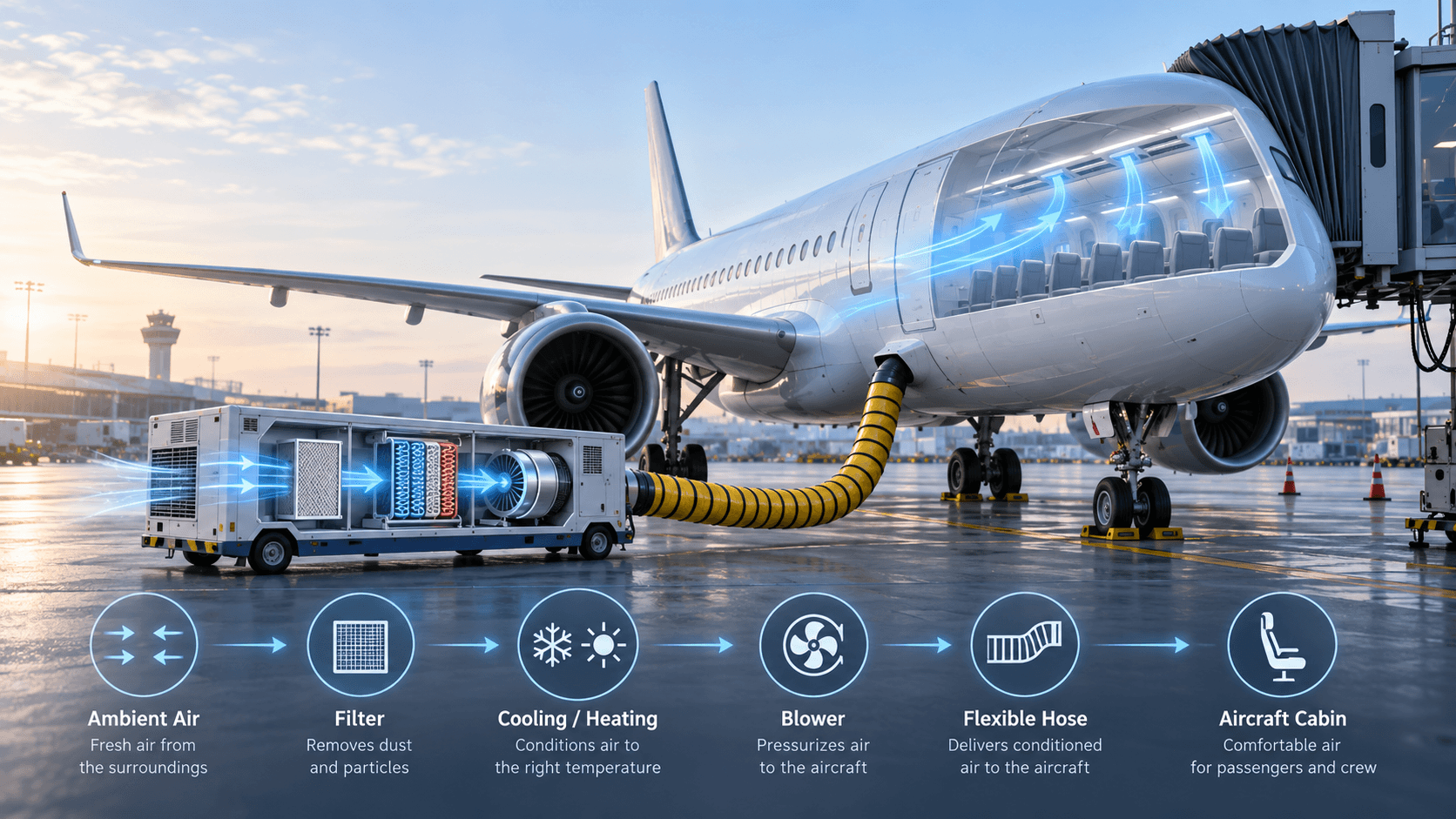
Understanding this process helps explain why cooling capacity alone cannot determine whether a PCA system will perform well at an airport.
For a basic introduction first, see What Is Aircraft Pre-Conditioned Air?.
Step 1 — Air Enters the PCA
The PCA draws ambient air into the unit.
Before the air enters the main air-conditioning system, filters may remove larger dust and contaminants.
This is especially important at airports where equipment operates in dusty or polluted environments.
Step 2 — The Air Is Cooled
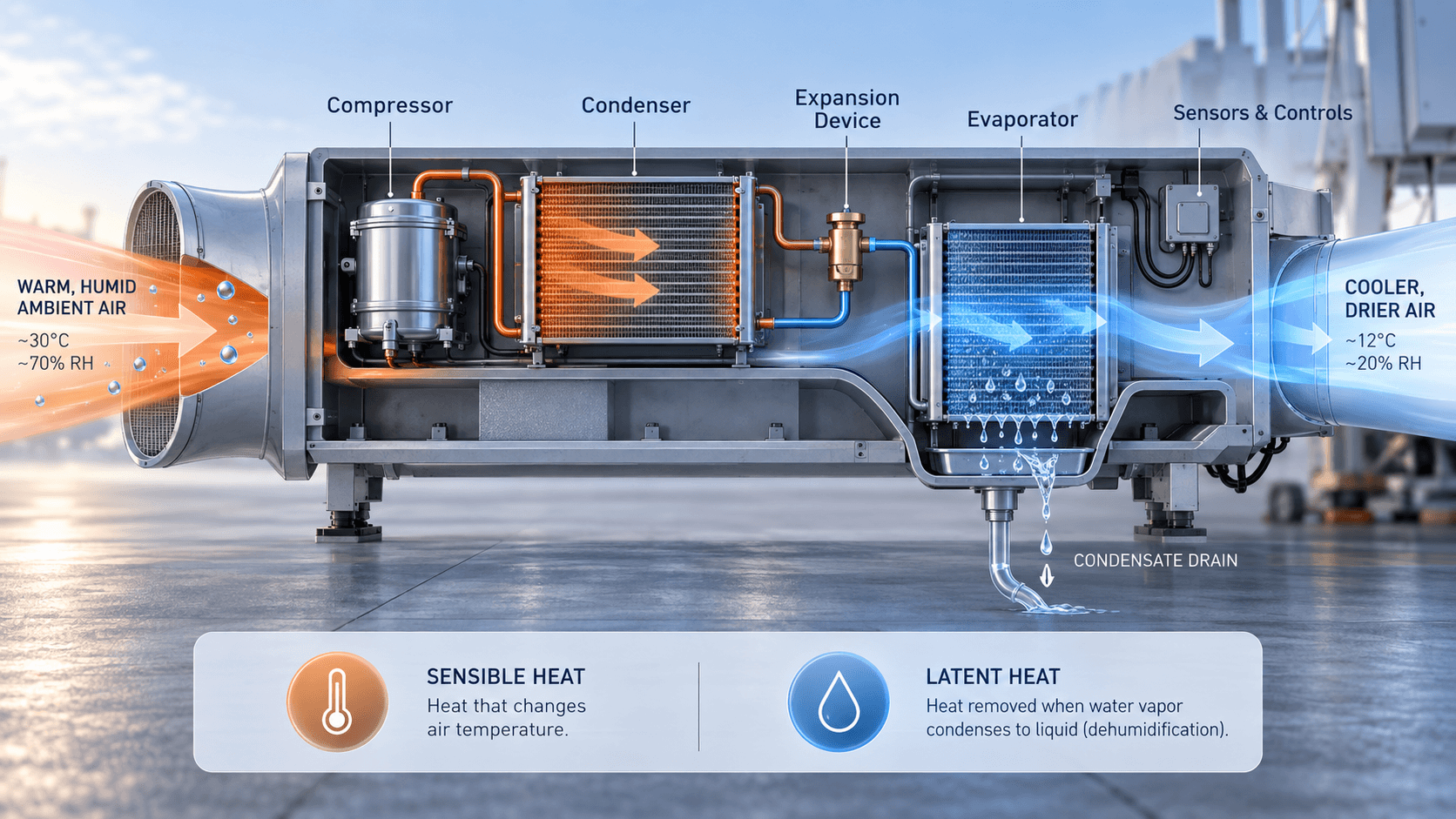
In a direct-expansion PCA system, cooling is normally created using a refrigeration cycle.
Major components typically include:
❄️ compressors;
🌡️ condensers;
⚙️ expansion devices;
💨 evaporators;
🔧 refrigerant piping;
🎛️ sensors and controls.
The compressor circulates refrigerant through the refrigeration system.
Heat is absorbed from the air at the evaporator and rejected to the outdoor environment through the condenser.
The result is air at a lower temperature.
Step 3 — Moisture May Also Be Removed
Cooling air does more than reduce temperature.
When humid air passes across a sufficiently cold evaporator, moisture can condense.
This means a PCA operating in hot and humid environments may need to manage both:
sensible heat — temperature reduction;
and
latent heat — moisture removal.
This is one reason why humidity needs to be considered when comparing PCA performance.
Step 4 — The Blower Generates Airflow
Cold air is only useful if it can reach the aircraft.
A blower moves the conditioned air through the system.
Two parameters are particularly important:
💨 Airflow
How much air the PCA delivers.
📈 Static Pressure
How effectively the PCA can overcome resistance in the air-delivery system.
A PCA may produce sufficient cooling capacity but still perform poorly if the air cannot reach the aircraft at the required flow rate.
Step 5 — Air Travels Through the PCA Hose
The conditioned air travels from the PCA outlet through an insulated flexible hose.
This hose is a critical part of the system.
Its performance is affected by:
diameter;
length;
insulation;
bends;
compression;
internal condition;
aircraft connector.
Long hoses generally create greater pressure losses.
They may also allow more heat to enter the conditioned air before it reaches the aircraft.
This is especially relevant for bridge-mounted systems where the PCA may be installed some distance from the aircraft connection.
Step 6 — Conditioned Air Enters the Aircraft
The hose connects to the aircraft's ground air-conditioning inlet.
Conditioned air then enters the aircraft distribution system and helps reduce or increase cabin temperature.
The final result depends on more than the PCA itself.
Factors include:
✈️ aircraft size;
🌡️ initial cabin temperature;
☀️ solar load;
👥 passenger load;
💡 internal equipment load;
🚪 open aircraft doors;
💨 airflow distribution.
Why Static Pressure Matters
Static pressure is one of the most important and often misunderstood PCA parameters.
Imagine two installations.
In the first:
PCA → 5 m hose → aircraft.
In the second:
PCA → long under-bridge duct → several bends → aircraft.
Both may use the same aircraft.
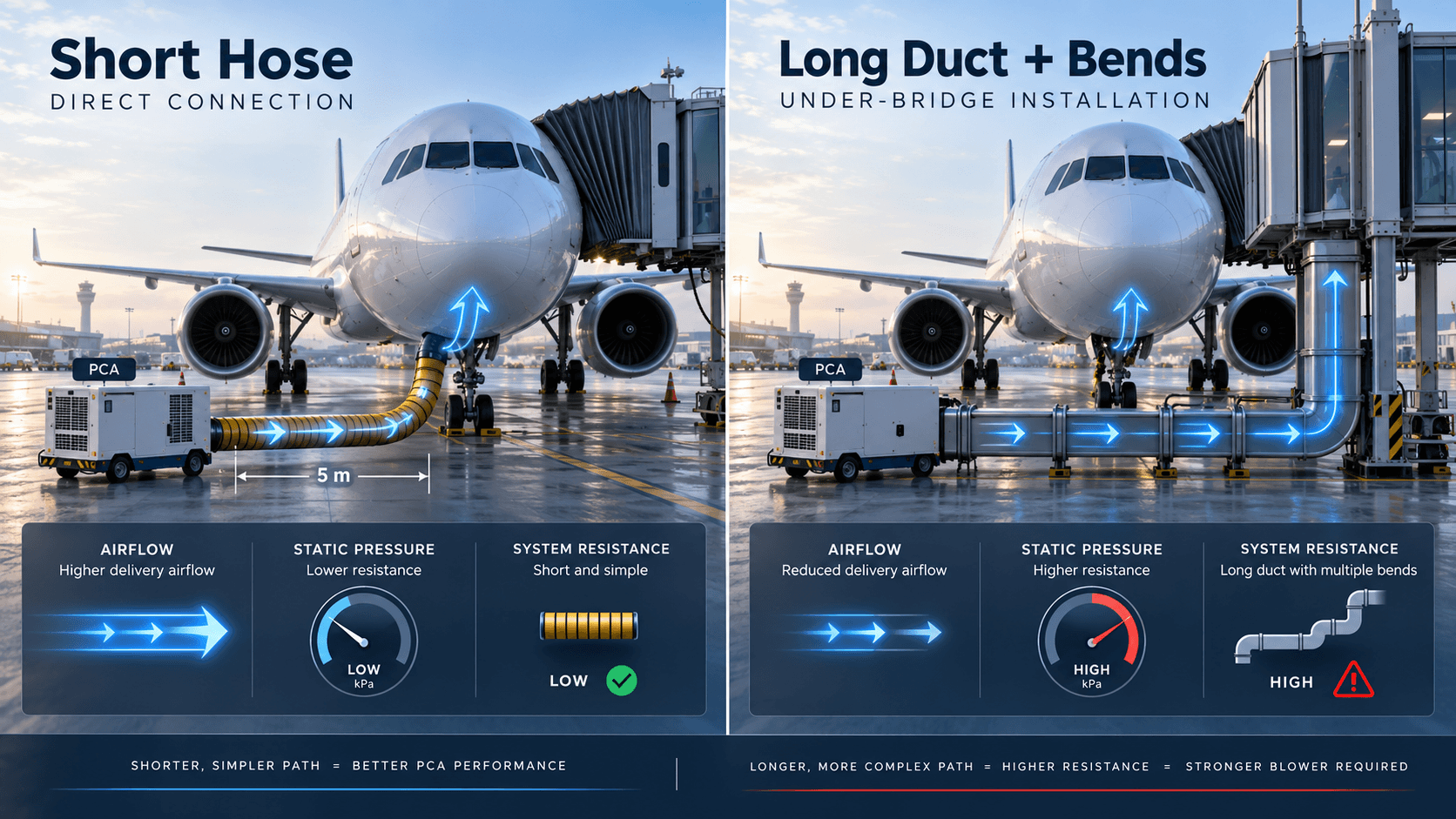
But the second system creates significantly greater resistance.
The PCA therefore needs enough blower capability to maintain the required airflow despite those losses.
This is why airflow and static pressure need to be considered together.
For a more detailed explanation, see Airflow, Static Pressure and Hose Length in Aircraft PCA.
Why Ambient Temperature Changes PCA Performance
Refrigeration equipment does not operate independently of outdoor conditions.
When ambient temperature increases, the condenser must reject heat into a hotter environment.
At the same time, the aircraft itself may require more cooling.
This creates two simultaneous challenges:
🔥 aircraft heat load increases;
🔥 refrigeration heat rejection becomes more demanding.
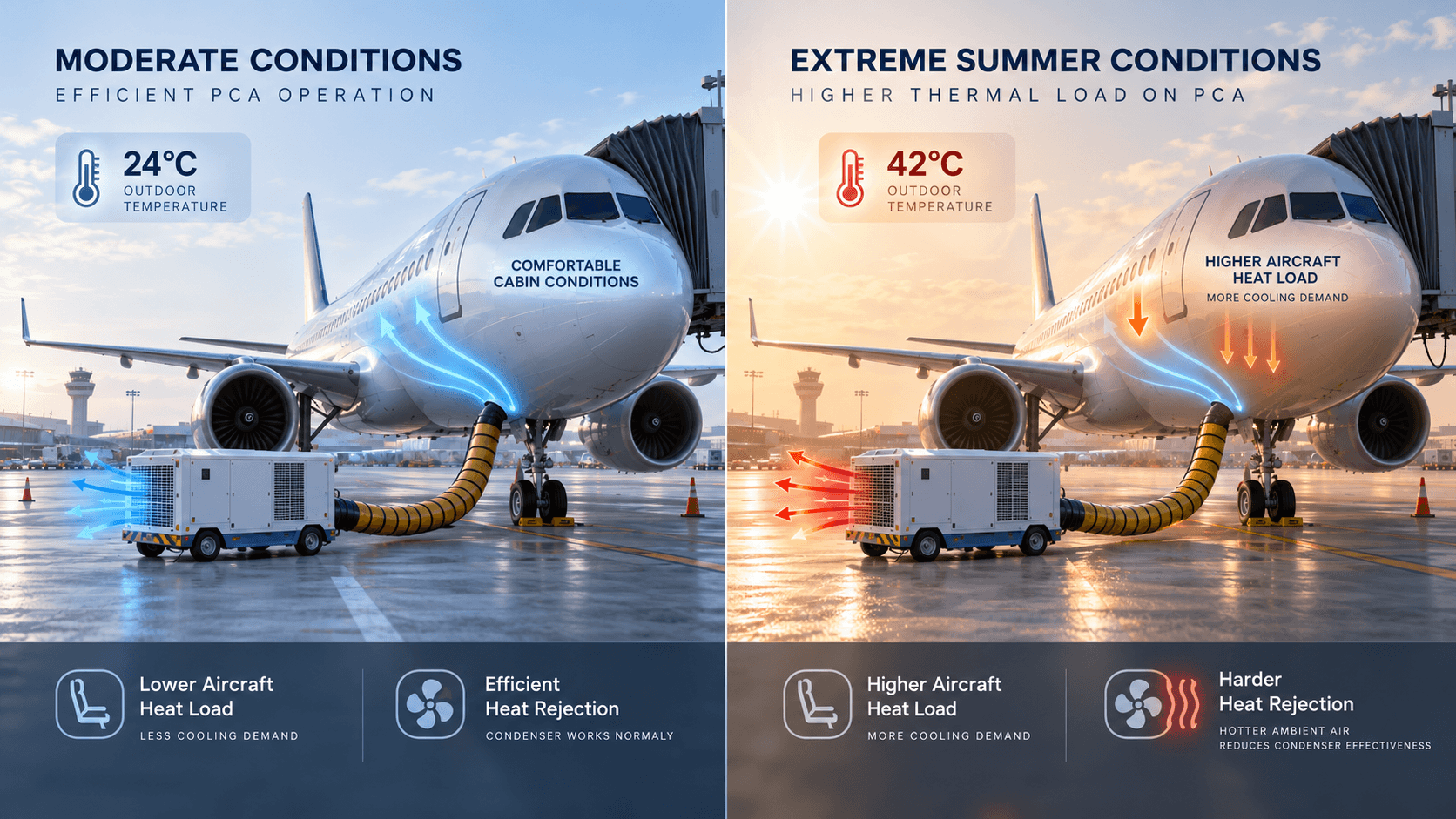
Therefore, PCA performance at moderate conditions should not automatically be assumed to represent performance in extreme summer climates.
DX PCA vs Chilled-Water PCA
Not every PCA generates cooling in the same way.
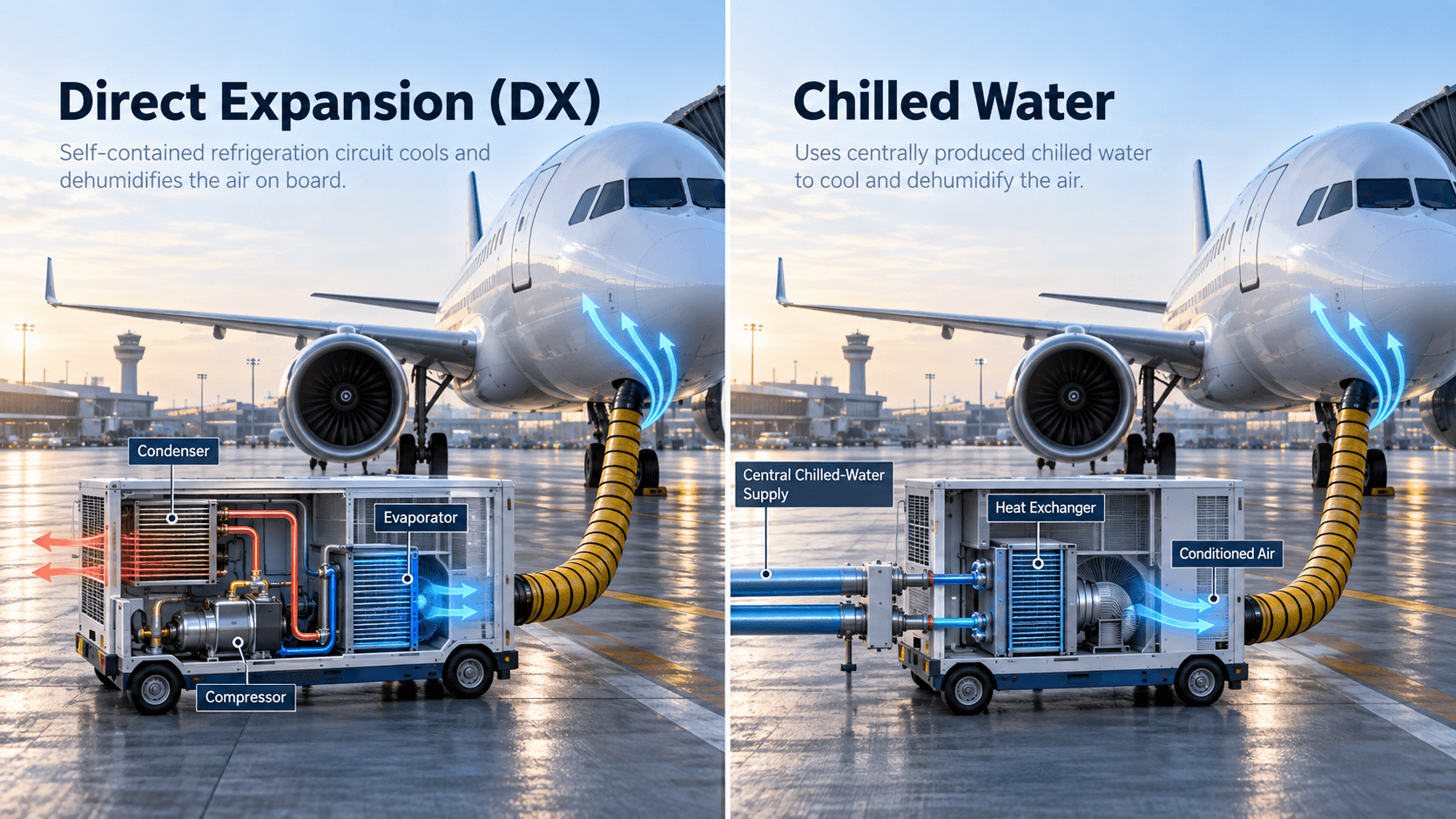
❄️ Direct Expansion
DX systems contain a refrigeration circuit inside the PCA equipment.
Advantages may include independent operation and reduced dependence on central chilled-water infrastructure.
💧 Chilled Water
A chilled-water system receives cold water from centralized airport infrastructure.
The PCA then transfers cooling from the chilled water into the air supplied to the aircraft.
The correct solution depends on airport infrastructure, gate design and lifecycle strategy.
The Complete PCA System
The most useful way to evaluate a PCA installation is:
Refrigeration + Blower + Duct + Connector + Aircraft

not simply:
Cooling Capacity
A weakness in any one part of this chain can reduce overall system performance.
For airports evaluating new equipment, system design should therefore begin with the actual aircraft, climate and gate configuration.
Explore YCair aircraft PCA solutions for different airport and aircraft applications.